






|
Aka Akarette II |
 Version française Version française |
Manufactured or assembled in Germany from 1950 to 1954.
Index of rarity in France: Rare (among non-specialized garage sales)
Inventory number: 14447
See the complete technical specifications
Chronology of cameras Aka
Although it had a short existence, the Aka company produced quite a large number of camera models. They all share a high quality of manufacture. The first series was called Akarette. It was soon accompanied by the Akarelle series. A few years later, a change in the design of the cameras led to the appearance of the Arette series,
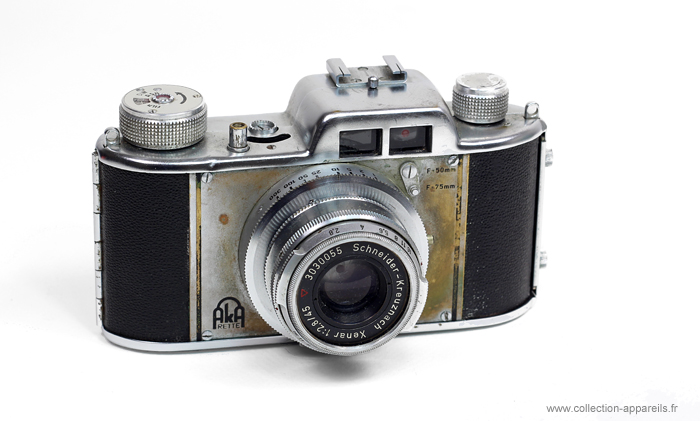
The Akarette cameras are small interchangeable-lens cameras. Their top cover features a characteristic bulge, as the viewfinder is dual, in order to correspond to two different focal lengths. These are indicated beneath the front face of the two windows. A button allows a marker to be moved, in one of the two parts of the viewfinder, so that the photographer can remember the focal length currently in use. Of course, the photographer must move this marker manually when changing the lens.
In 1950, the Akarette II replaced the Akarette I, alongside the Akarette 0. The manufacturing quality remained the same but slightly less luxurious. The black lacquer was replaced by chrome. An accessory shoe appeared above the housing. The small button for blocking one of the two parts of the viewfinder was replaced by a small lever.
The shutter used was a Prontor-S, including a self-timer. This self-timer was absent from the cheaper Akarette 0 version.
Changing the lens on the Akarette can be a bit perplexing, as it does not use a bayonet or a screw-in lens. There are four rings around the lens barrel. Starting from the body, the first ring controls the speed, the third controls the aperture, and the fourth controls the distance. The second ring is unscrewed to release the lens.
Another unique feature is that the frame counter does not advance during winding but only upon shutter release.
During its commercialization, the Akarette II underwent a few modifications.
In this particular example, the back does not have a table for calculating the shutter speed/aperture combination, and the winding and rewinding knobs have a diamond pattern without vertical lines. The screw securing the rewinding knob is not visible.
The history of the Aka brand (acronym for Apparate & Kamerabau) is closely linked to that of the Second World War and its consequences. The brand was created in 1946 by the two Armbuster brothers, in the French sector1. One of the two brothers had expertise in camera production, having worked for major German manufacturers of cameras and shutters. The other owned a foundry and a tooling factory.
The production of a camera with a central shutter and interchangeable lens began in a former hotel in Wildbad. This camera was called the Akarette and was intended as a more affordable competitor to the Leica. The first examples produced negatives measuring 24 x 32 mm, which made it possible to increase the number of exposures per film. It quickly reverted to the 24 x 36 format, which had become a standard. Production gradually increased with the recovery of the German economy, making a move to larger premises necessary. Unable to find suitable facilities in Wildbad, the company relocated to the shores of Lake Constance, in Friedrichshafen, in the former flight training school2. Production started there in April 1949. It diversified with simpler models than the first Akarette, as well as more advanced models equipped with a rangefinder.
In 1958, one of the two brothers left the company for Feinwerktechnik, while he was developing a stereo camera compatible with the View-Master, the financing of which was a source of dispute between the brothers. This departure marked the beginning of the company's decline. Bankruptcy came in 1960. A new company, Arette Feinwerktechnik GmbH, continued to build cameras until 1963, using remaining stock parts.
Aka cameras are sometimes found at French flea markets. Sellers familiar with the history of their camera often mention that it was purchased by a conscript doing his military service in Germany, either in the Black Forest or around Lindau, in the 1950s.
1 As a reminder, the French sector, like the American, British and Soviet sectors, was a result of the Yalta agreements, which defined the division of Nazi Germany among the victors. Each occupying power exercised full administration over its sector. In 1949, the creation of the two German states considerably reduced the prerogatives of the four occupying nations. A military presence was maintained until after reunification, in 1993.
2 Friedrichshafen is the city of the Zeppelin airships and Dornier aircraft
(original source in German)
Interesting links or bibliography :
Add a link or element of bibliography, a picture taken with this camera, a picture of box or an ads about this camera
Your photos taken with the same camera:
Cameras from Ebay France (Aka) (Uploaded each 3 hours)
 appareil 35mm 1956 AKA ARETTE 1A bon état, déclenche , non testé avec film 17.22 euros Finira le 27-09-2026 à 14:03:40 |